Software Engineering


Silwatech is backed by a team of 1000+ employees, serving clients in over 10+ industries across 9+ locations

At SilwaTech, we believe successful digital transformation is driven not by technology alone, but by disciplined execution, governance, and clarity.
Our Software Development Life Cycle (SDLC) framework ensures that every project, whether for Government, BFSI, Healthcare, or Enterprise, follows a structured approach with defined accountability, risk control, and transparent reporting.
We do not rely on informal execution.
We rely on process, documentation, validation, and measurable checkpoints.

What we do:
We conduct detailed requirement workshops, stakeholder interviews, feasibility studies, risk identification, and documentation of both functional and non-functional requirements.
Why it is important & benefits:
Most project failures originate from unclear requirements. This phase ensures alignment between business expectations and technical feasibility. It reduces scope confusion, prevents misinterpretation, and sets a strong foundation for project success.
What we do:
We design the technical architecture, security framework, integration structure, UI/UX flows, data models, and scalability blueprint.
Why it is important & benefits:
A poorly designed system becomes expensive to maintain and impossible to scale. Strong architecture ensures long-term performance, security, maintainability, and future expansion capability.

What we do:
We develop software in controlled sprint cycles, using version control, peer code reviews, CI/CD pipelines, and regular stakeholder demos.
Why it is important & benefits:
Controlled sprint execution ensures visibility, adaptability, and incremental value delivery. It reduces surprises at the end of the project and allows early feedback.


What we do:
We conduct structured testing, including unit, integration, system, UAT support, performance, and security validation.
Why it is important & benefits:
Undetected defects lead to production failures, reputational damage, and financial loss. A disciplined testing process ensures stability, compliance, and production readiness.
What we do:
We manage environment setup, deployment planning, rollback strategies, final validation, and production release management.
Why it is important & benefits:
Deployment failures can disrupt operations and damage trust. Structured go-live planning ensures minimal downtime, controlled release, and operational continuity.

Every project is different. We adapt methodology based on regulatory environment, project complexity, and stakeholder requirements.
Agile is ideal for projects where requirements are expected to evolve based on user feedback, market shifts, or regulatory changes. It works well in AI/ML, digital products, mobile applications, and customer-facing platforms where rapid iteration and continuous improvement are essential. Agile allows early visibility of working software, helping stakeholders validate direction before major investments are made. It is particularly effective when speed to market and adaptability are critical success factors.

Digital platforms, AI initiatives, SaaS products, innovation programs, and evolving business models.
A waterfall approach is most effective when project requirements are clearly defined and unlikely to change significantly. It is commonly used in government, BFSI, healthcare, and other regulated sectors where documentation, audit trails, and formal approvals are mandatory. This approach ensures strong scope control, well-defined deliverables, and contractual clarity. It minimizes ambiguity and is preferred in environments where compliance, traceability, and milestone-based validation are critical.
Government systems, compliance-driven applications, ERP implementations, and fixed-scope enterprise platforms.

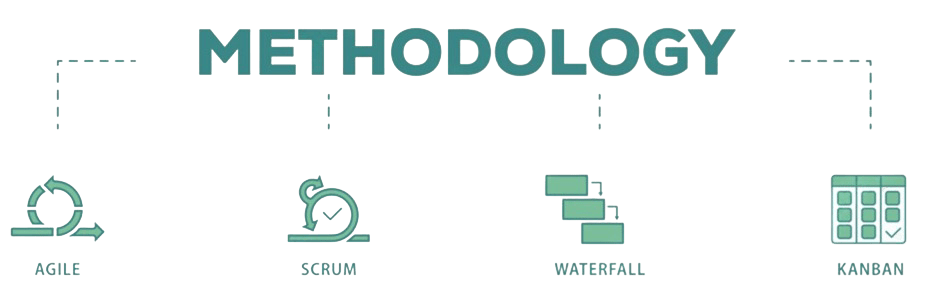
Hybrid methodology combines the governance strength of Waterfall with the flexibility of Agile. It is ideal for enterprise environments where regulatory documentation is required, but innovation and iteration are equally important. For example, core architecture and compliance modules may follow a structured planning approach, while UI/UX, analytics, or AI components may evolve in Agile sprints. Hybrid work models work especially well for large organizations, balancing risk control with business agility.
Enterprise digital transformation, large-scale modernization programs, multi-phase implementations, and regulated yet innovation-driven projects.
Technology projects involve financial, operational, and reputational risk. Without governance, projects suffer from scope creep, confusion over accountability, and uncontrolled risk.
Strong governance ensures:
Many disputes arise due to a lack of communication. Structured reporting eliminates ambiguity and ensures real-time visibility for stakeholders.
Strong project management ensures that timelines, budgets, scope, and stakeholder expectations remain aligned throughout the engagement. Structured reporting creates transparency, eliminates ambiguity, and enables proactive decision-making before risks escalate into disputes.
Level 1 – Project Manager
Level 2 – Delivery Head
Level 3 – Executive Sponsor
Security is not added at the end. It is integrated from the beginning. Security failures result in legal penalties, loss of public trust, and operational disruption. Embedding security early reduces compliance risk and long-term cost.
DevOps integrates development and operations to enable faster, safer releases. Manual deployments increase error risk. DevOps reduces downtime, improves release stability, and accelerates innovation without compromising quality.
We offer flexible engagement structures to align with client needs.
This model is ideal when requirements, deliverables, and timelines are clearly defined upfront. It provides budget predictability and contractual clarity, making it suitable for government tenders, compliance-driven systems, and projects with minimal change. Best for clearly defined projects with stable requirements.
Example: Government portal with defined features.
This model supports flexibility when requirements may evolve during execution. Clients pay based on actual effort and time invested, making it ideal for innovation projects, AI initiatives, digital transformation programs, and exploratory development. Best for evolving projects or research-driven initiatives.
Example: AI or innovation-driven platform.
A dedicated team works exclusively on the client’s product, functioning as an extended in-house team. This model ensures continuity, retention of domain knowledge, faster iteration cycles, and strategic alignment for growing digital platforms. Best for long-term product development.
Example: Enterprise SaaS product development.
Under this model, SilwaTech takes end-to-end responsibility for maintaining, optimizing, and enhancing systems post-deployment. It ensures operational stability, performance optimization, SLA-based support, and predictable long-term cost management. Best for ongoing maintenance and support.
Example: Government enterprise application post-launch.
Most project disputes arise from unclear scope, misaligned expectations, weak documentation, or poor communication. Our structured governance, transparent reporting, formal change management, and milestone-based validation processes ensure clarity at every stage, significantly reducing risk, conflict, and delivery uncertainty.
This protects both client and vendor.
Delivering reliable, scalable, compliant systems requires discipline.
At SilwaTech, our methodology is designed to reduce uncertainty, manage risk, and ensure structured success, from idea to long-term operational stability.
If you are evaluating us as a technology partner, our delivery framework ensures your project is in safe hands.
Our project experience spans government authorities, regulated enterprises, and major organisations across multiple industries.
References shown may include direct SilwaTech engagements and work delivered through our contracted partner network. Inclusion does not imply a direct contractual relationship with, or endorsement of, SilwaTech.













Engage with our enterprise team to discuss your digital transformation goals, platform modernization initiatives, or large-scale system requirements. We’re ready to support your next strategic technology move.

