


In the Banking, Financial Services, and Insurance (BFSI) sector, data is one of the most valuable business assets. Every customer interaction, financial transaction, insurance claim, loan application, investment decision, and regulatory report depends on accurate, secure, and accessible data. As financial institutions continue to embrace digital transformation, cloud computing, artificial intelligence (AI), and advanced analytics, managing data effectively has become more critical than ever.
However, the growing volume and complexity of enterprise data also introduce significant challenges. Financial organizations must deal with fragmented data sources, legacy systems, evolving regulatory requirements, cybersecurity threats, and increasing customer expectations for personalized digital services. Without a structured approach to governing data, organizations risk making poor business decisions, failing compliance audits, exposing sensitive customer information, and reducing operational efficiency.
A robust Data Governance Framework helps BFSI organizations establish consistent policies, responsibilities, and controls for managing data throughout its lifecycle. Rather than treating data governance as a compliance exercise, leading financial institutions view it as a strategic capability that improves decision-making, strengthens risk management, enhances customer trust, and supports innovation.
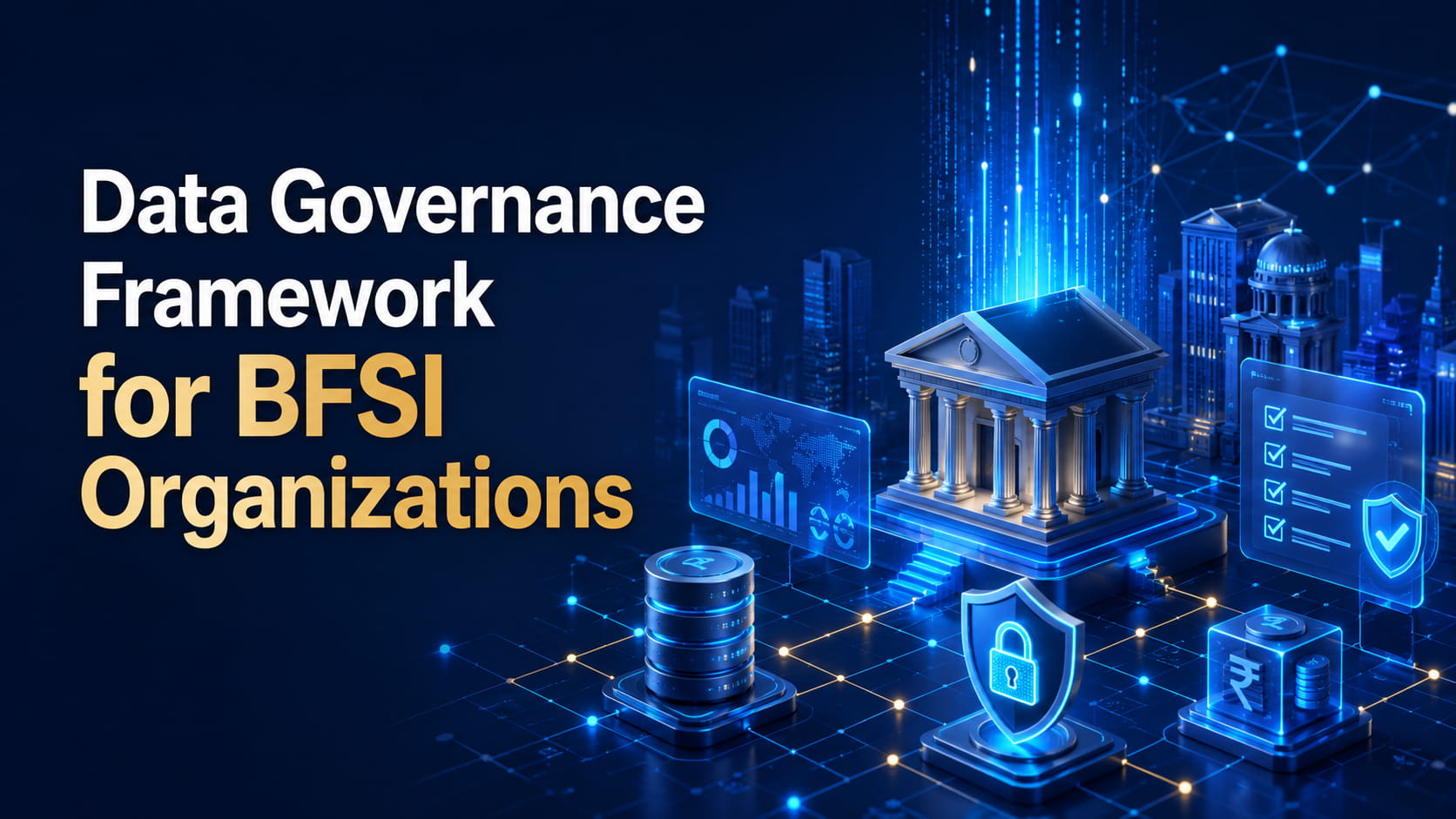
This guide explores the key components of a modern data governance framework for BFSI organizations, including governance principles, data quality, security, compliance, ownership, architecture, and best practices for successful implementation.
Understanding Data Governance in BFSI
Data governance is the framework of policies, processes, standards, technologies, and organizational roles that ensure enterprise data is accurate, secure, consistent, and used responsibly.
For BFSI organizations, data governance extends beyond managing databases. It creates accountability for how data is collected, stored, shared, protected, and eventually archived or deleted. Every department—from retail banking and insurance operations to compliance, finance, risk management, and customer service—relies on governed data to perform effectively.
A successful governance framework ensures that employees can trust the information they use while maintaining strict compliance with industry regulations and internal security policies.
Why Data Governance Matters for Financial Institutions
Financial institutions generate enormous volumes of structured and unstructured data every day. This information supports lending decisions, fraud detection, regulatory reporting, customer onboarding, digital banking, insurance underwriting, and investment management.
Without proper governance, organizations may experience inconsistent reporting, duplicate records, security vulnerabilities, and poor customer experiences.
An effective governance framework helps organizations:
- Improve data accuracy and consistency
- Strengthen regulatory compliance
- Reduce operational risk
- Enhance cybersecurity and privacy
- Support AI and analytics initiatives
- Improve customer trust
- Enable faster decision-making
- Increase operational efficiency
Beyond operational improvements, governance establishes confidence in enterprise data, allowing leadership teams to make strategic decisions based on reliable information.
Core Principles of a Data Governance Framework
Every successful framework should be built on several foundational principles.
Data Ownership and Accountability
Governance begins by clearly defining who is responsible for enterprise data.
Every critical dataset should have an assigned business owner responsible for data quality, usage policies, compliance requirements, and lifecycle management. Technical teams may maintain infrastructure, but business stakeholders remain accountable for how data supports organizational objectives.
Clear ownership also reduces ambiguity when data quality issues, security incidents, or regulatory questions arise.
Data Quality Management
Poor-quality data affects customer service, financial reporting, fraud detection, and business intelligence.
Data quality management focuses on ensuring information is:
- Accurate
- Complete
- Consistent
- Timely
- Valid
- Unique
Rather than correcting data after problems occur, organizations should establish automated validation, monitoring, and quality controls throughout the data lifecycle.
Reliable data is the foundation for trustworthy analytics and informed business decisions.
Data Security and Privacy
Because BFSI organizations manage highly sensitive financial and personal information, security must be embedded within every governance process.
Data should be protected through layered security controls that include encryption, identity and access management, network security, continuous monitoring, and secure backup strategies.
Organizations should also implement strong authentication mechanisms and apply the principle of least privilege to reduce unnecessary access to confidential information.
Protecting customer privacy is equally important. Governance policies should clearly define how sensitive information is collected, processed, shared, retained, and securely disposed of.
Regulatory Compliance
The financial sector operates within a complex regulatory landscape that continues to evolve.
A mature governance framework should help organizations demonstrate compliance through standardized policies, audit trails, documentation, reporting, and monitoring.
Rather than treating compliance as a one-time project, governance should support continuous compliance by integrating regulatory requirements into everyday business processes.
Compliance teams, legal departments, IT, and business units should collaborate to ensure governance policies remain aligned with changing regulations.
Data Governance Operating Model
A governance framework requires clearly defined organizational roles.
Executive Leadership
Executive sponsors establish governance objectives, allocate resources, approve policies, and promote a data-driven culture throughout the organization.
Data Governance Council
A governance council provides strategic oversight, approves standards, resolves cross-department issues, and monitors governance performance.
Data Owners
Business data owners define quality expectations, access requirements, and business rules for specific datasets.
Data Stewards
Data stewards monitor data quality, coordinate issue resolution, maintain metadata, and ensure governance policies are followed within their business domains.
IT and Security Teams
Technology teams implement governance controls through infrastructure, security platforms, databases, cloud environments, and monitoring tools.
Clearly defined responsibilities improve accountability and reduce governance conflicts.
Building a Data Governance Architecture
Technology plays an important role in enabling governance, but governance should always be driven by business objectives rather than software alone.
A typical governance architecture includes:
- Enterprise data repositories
- Data integration platforms
- Metadata management
- Master Data Management (MDM)
- Data catalogs
- Data quality tools
- Security platforms
- Monitoring and reporting solutions
These technologies work together to provide visibility into enterprise data assets while supporting governance processes.
Metadata Management
Metadata is often described as “data about data.”
It helps organizations understand where data originates, how it is transformed, who owns it, and how it should be used.
Well-managed metadata improves:
- Data discovery
- Business glossary management
- Regulatory reporting
- Data lineage
- Impact analysis
- Analytics accuracy
For large financial institutions with multiple legacy systems, effective metadata management significantly improves operational transparency.
Master Data Management
Financial organizations often maintain customer information across multiple applications.
Without proper coordination, duplicate or inconsistent records can create operational inefficiencies and compliance risks.
Master Data Management (MDM) establishes a trusted source of critical enterprise information, including:
- Customer profiles
- Accounts
- Products
- Vendors
- Branches
- Policies
Consistent master data improves customer service, reporting accuracy, and regulatory compliance.
Data Lifecycle Management
Governance extends throughout the complete lifecycle of enterprise data.
Organizations should define policies covering:
- Data creation
- Classification
- Storage
- Usage
- Sharing
- Archiving
- Retention
- Secure disposal
Lifecycle management ensures information remains protected while supporting legal and business requirements.
Regular reviews help prevent unnecessary storage costs and reduce the risks associated with retaining outdated information.
Data Governance for Cloud and Hybrid Environments
Many BFSI organizations now operate across on-premises infrastructure, private cloud, and public cloud platforms.
A governance framework should provide consistent policies regardless of where data resides.
Organizations should establish standardized controls for:
- Identity management
- Encryption
- Access control
- Monitoring
- Backup
- Data residency
- Vendor risk
Hybrid environments require particular attention to secure data movement and consistent policy enforcement.
Supporting AI and Advanced Analytics
Artificial intelligence and predictive analytics depend on reliable, well-governed data.
Poor data quality can produce inaccurate models, biased outcomes, and unreliable business insights.
Governance should ensure that data used for machine learning is properly classified, validated, documented, and monitored.
Organizations should also establish governance policies for AI model transparency, explainability, and ongoing performance monitoring.
Measuring Data Governance Success
A governance program should include measurable performance indicators rather than relying solely on policy documentation.
Common metrics include:
- Data quality scores
- Duplicate record reduction
- Regulatory compliance performance
- Security incidents
- Data access request turnaround time
- Metadata coverage
- Policy compliance rates
- Customer data accuracy
These KPIs help leadership evaluate governance maturity and identify opportunities for continuous improvement.
Common Data Governance Challenges
Implementing governance across a large financial institution can be challenging.
Common obstacles include:
- Legacy technology
- Data silos
- Unclear ownership
- Inconsistent standards
- Poor metadata
- Limited executive support
- Resistance to organizational change
Successful organizations address these challenges through executive sponsorship, phased implementation, employee training, and continuous governance reviews.
Best Practices for BFSI Data Governance
A successful governance framework combines technology, policies, and organizational accountability.
Financial institutions should:
- Establish executive sponsorship and governance leadership.
- Define clear data ownership and stewardship responsibilities.
- Standardize data quality policies across departments.
- Implement strong access controls and encryption.
- Maintain comprehensive metadata and data lineage.
- Integrate governance with regulatory compliance processes.
- Monitor governance metrics continuously.
- Automate data quality and compliance checks where possible.
- Regularly review governance policies.
- Foster a culture that treats data as a strategic business asset.
Governance should evolve alongside business objectives, regulatory changes, and technological advancements.
Implementing a Data Governance Roadmap
Organizations should approach governance as a phased initiative rather than attempting enterprise-wide implementation all at once.
Phase 1: Assess
Evaluate existing data assets, governance maturity, technology landscape, compliance obligations, and organizational readiness.
Phase 2: Define
Develop governance policies, ownership models, standards, and success metrics.
Phase 3: Implement
Deploy governance processes, supporting technologies, training programs, and quality controls.
Phase 4: Monitor
Track governance performance using defined KPIs, audit findings, and operational metrics.
Phase 5: Optimize
Continuously improve governance based on business needs, regulatory updates, technology modernization, and stakeholder feedback.
A phased approach reduces implementation risk while allowing organizations to demonstrate measurable business value.
Conclusion
As digital transformation accelerates across the BFSI sector, effective data governance has become a strategic necessity rather than simply a regulatory requirement.
A comprehensive data governance framework enables financial institutions to improve data quality, strengthen security, support compliance, reduce operational risk, and build greater confidence in enterprise information.
By establishing clear ownership, implementing standardized governance processes, investing in metadata and master data management, and embedding governance into everyday operations, BFSI organizations can create a trusted data foundation that supports innovation, customer experience, and long-term business growth.
Ultimately, organizations that treat data as a governed enterprise asset are better positioned to navigate regulatory change, leverage advanced analytics, strengthen cybersecurity, and deliver reliable financial services in an increasingly digital world.
FAQs
A data governance framework is a structured set of policies, processes, roles, and technologies that help banking, financial services, and insurance organizations manage data securely, accurately, and in compliance with regulatory requirements.
Data governance improves data quality, strengthens cybersecurity, supports regulatory compliance, reduces operational risk, enhances customer trust, and enables reliable analytics and business decision-making.
Key components include data ownership, data stewardship, data quality management, metadata management, master data management, security, privacy, regulatory compliance, lifecycle management, and continuous monitoring.
A well-defined governance framework provides standardized policies, audit trails, documentation, data lineage, and access controls that help organizations meet financial regulations and demonstrate compliance during audits.
Organizations should adopt a phased approach by assessing current data maturity, defining governance policies, assigning ownership, implementing governance technologies, monitoring KPIs, and continuously improving the framework based on business and regulatory needs.