


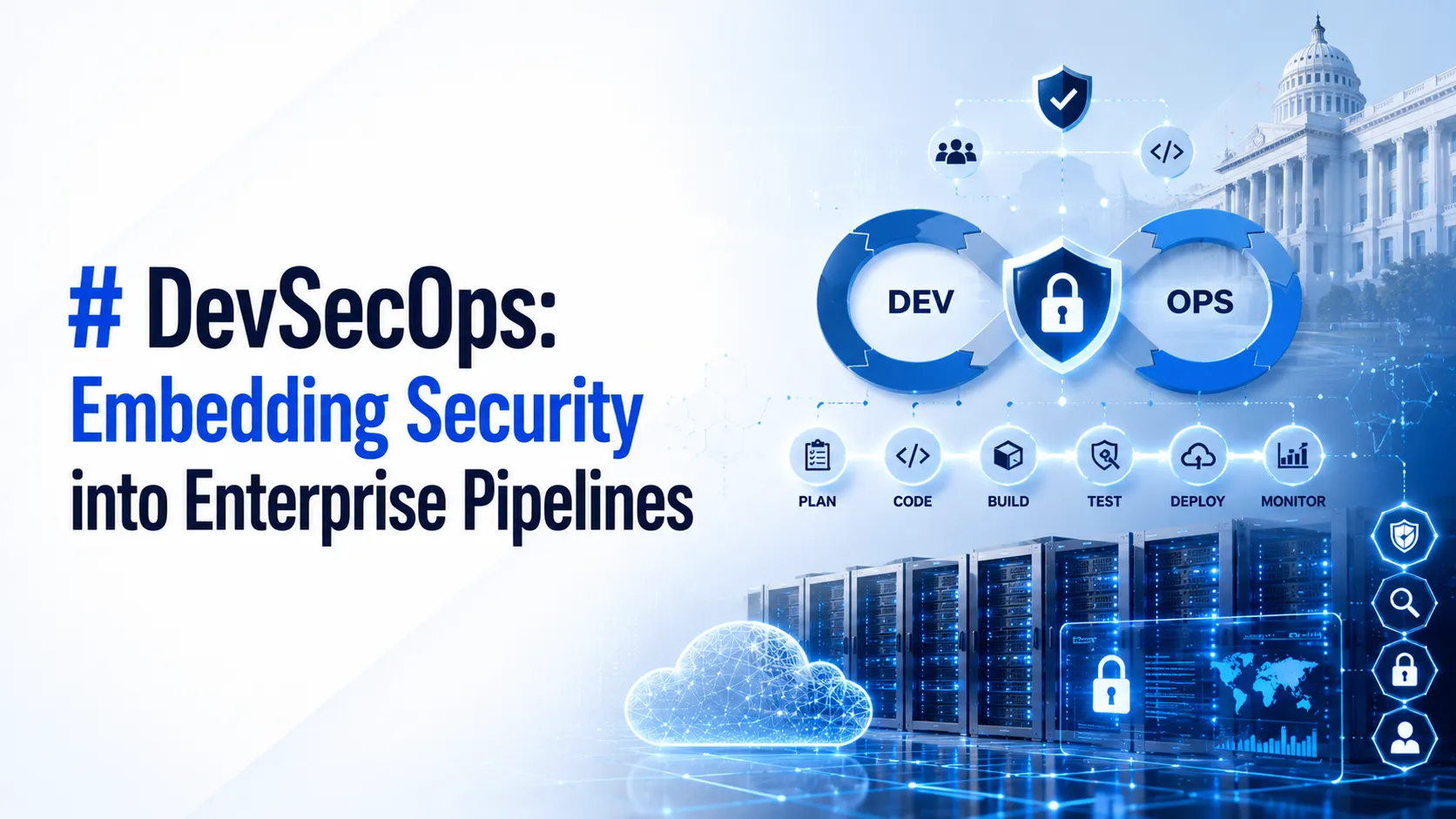
Enterprise software development has changed significantly as organizations adopt cloud platforms, microservices, containers, automation, and continuous delivery. Development teams are expected to release applications faster while supporting increasingly complex infrastructure and business requirements.
This acceleration creates an important challenge: security cannot remain a final-stage activity.
When security testing happens only after development is complete, vulnerabilities may be discovered late in the release cycle. Fixing them at that point can require substantial rework, delay deployments, and increase operational risk. Modern enterprises therefore need an approach that integrates security directly into software development and delivery.
DevSecOps addresses this challenge by bringing security into the development, operations, and delivery lifecycle. Instead of treating security as a separate approval step, DevSecOps makes security a shared responsibility supported by automation, policies, testing, monitoring, and continuous improvement.
For enterprise organizations, the goal is not simply to add more security tools to a CI/CD pipeline. A successful DevSecOps strategy creates a repeatable process in which applications, infrastructure, dependencies, containers, configurations, and deployments are continuously evaluated for security risks.
This guide explores how enterprises can embed security into modern software pipelines while maintaining development velocity, operational reliability, and governance.
What Is DevSecOps?
DevSecOps is an approach to software delivery that integrates security practices throughout the Software Development Lifecycle (SDLC).
Traditional development models often place security toward the end of the release process. Developers build the application, operations teams prepare the environment, and security teams perform reviews before production deployment.
DevSecOps shifts security much earlier in this process.
Security requirements can be considered during planning, code can be scanned during development, dependencies can be evaluated during builds, infrastructure configurations can be validated before deployment, and production environments can be continuously monitored.
This creates a more proactive security model.
The core idea is straightforward: security should be integrated into the same automated workflows used to build, test, deploy, and operate software.
Why DevSecOps Matters for Enterprise Organizations
Enterprise applications are rarely simple systems. A typical application may depend on open-source libraries, APIs, databases, cloud services, containers, infrastructure-as-code, identity platforms, and third-party integrations.
Each dependency introduces potential security considerations.
At the same time, organizations are under pressure to release new features quickly. Manual security reviews performed at the end of every development cycle can become bottlenecks.
DevSecOps helps address both challenges by shifting security activities closer to the point where changes are introduced.
This can provide several benefits:
- Earlier identification of vulnerabilities
- Reduced remediation costs
- More consistent security controls
- Faster and more repeatable releases
- Better collaboration between teams
- Improved visibility into software risk
The objective is not to slow development down with additional controls. It is to make security a natural part of the delivery process.
Moving Security to the Left
“Shift left” is a common concept in DevSecOps. It means moving security activities earlier in the software development lifecycle.
For example, instead of discovering a vulnerable dependency immediately before production deployment, developers can receive feedback when the dependency is introduced.
Similarly, infrastructure configurations can be evaluated before they are provisioned, and container images can be scanned before they enter a production registry.
Earlier detection generally makes remediation easier because the change is still fresh in the developer’s context.
However, shifting security left should not mean shifting all responsibility onto developers. Enterprise security requires collaboration between development, security, operations, architecture, and governance teams.
Security Across the CI/CD Pipeline
A mature DevSecOps pipeline introduces security controls across multiple stages.
The exact implementation varies by organization, but a typical pipeline may include source-code analysis, dependency checks, testing, container scanning, infrastructure validation, artifact verification, deployment controls, and runtime monitoring.
Security gates should be designed according to risk. Not every finding should automatically block a production deployment.
Organizations need policies that distinguish between critical vulnerabilities, acceptable risks, false positives, and issues requiring remediation after deployment.
This helps prevent security automation from becoming unnecessarily disruptive.
Secure Source Code Management
Source code is the foundation of the software supply chain.
Enterprise development environments should protect source repositories through strong authentication, access controls, branch protection, code review processes, and audit logging.
Developers should also be protected against accidentally committing credentials, API keys, private certificates, or other sensitive information.
Automated secret scanning can identify potential credentials before they reach production systems.
Source-code security should also include appropriate static analysis to identify coding patterns associated with common vulnerabilities.
The earlier these issues are detected, the less expensive they typically are to remediate.
Static Application Security Testing
Static Application Security Testing (SAST) analyzes source code or compiled code for potential security vulnerabilities.
SAST can identify problems such as insecure coding patterns, injection risks, unsafe data handling, and other application-level weaknesses.
Integrating SAST into CI pipelines allows developers to receive feedback during development rather than waiting for a separate security assessment.
However, automated scanners are not perfect. Organizations should establish severity thresholds and remediation policies so that development teams know which findings require immediate action.
SAST is most effective when combined with other security testing approaches rather than used as the only application security control.
Software Composition Analysis
Modern enterprise applications frequently depend on open-source components.
Software Composition Analysis (SCA) helps organizations identify third-party dependencies and evaluate them for known vulnerabilities, licensing considerations, and outdated versions.
This is particularly important because a vulnerability in a widely used library can affect many applications simultaneously.
Organizations should maintain visibility into their dependency inventory and establish processes for monitoring newly disclosed vulnerabilities.
Automated dependency updates can also help teams reduce technical debt while maintaining security.
Container Security
Containers are widely used in modern enterprise architectures, particularly with microservices and cloud-native applications.
However, containerization introduces its own security considerations.
Organizations should scan container images for vulnerabilities, use trusted base images, minimize unnecessary packages, and ensure images are built through controlled pipelines.
Container registries should also be protected through appropriate access controls and artifact management practices.
Security policies should continue into runtime environments. A secure image can still become risky if it is deployed with excessive privileges or unnecessary access to host resources.
Infrastructure as Code Security
Infrastructure as Code (IaC) allows organizations to define cloud and infrastructure configurations through version-controlled code.
Tools and practices can evaluate infrastructure definitions before they are deployed.
For example, automated checks can identify overly permissive network rules, publicly exposed resources, weak encryption settings, or inappropriate access configurations.
This allows infrastructure security issues to be detected during the development process rather than after deployment.
IaC also creates an auditable history of infrastructure changes, which can support governance and compliance requirements.
Secrets Management
Secrets are one of the most sensitive elements in an enterprise pipeline.
Passwords, tokens, certificates, API credentials, and encryption keys should not be embedded directly into source code or configuration files.
DevSecOps pipelines should integrate with appropriate secrets-management mechanisms and restrict access according to the principle of least privilege.
Secrets should also have defined rotation and revocation processes.
Security teams should assume that credentials can eventually be exposed and design systems so that compromised credentials can be invalidated quickly.
Securing the Software Supply Chain
Software supply chain security has become increasingly important as applications depend on numerous external components and automated build systems.
A secure supply chain strategy should provide visibility into where software components originate and how they move through the development process.
Organizations can strengthen supply chain security through:
- Trusted source repositories
- Controlled build environments
- Dependency scanning
- Software Bill of Materials (SBOM)
- Artifact signing
- Secure container registries
- Deployment verification
The objective is to ensure that software reaching production is traceable and has passed appropriate security controls.
API Security
Enterprise applications increasingly depend on APIs to communicate between applications, services, partners, and customers.
API vulnerabilities can expose sensitive information or allow unauthorized actions.
DevSecOps pipelines should therefore include API security testing where appropriate. Authentication, authorization, input validation, rate limiting, and data exposure should be evaluated throughout the API lifecycle.
API specifications should also be versioned and documented so that security and architectural requirements remain consistent as services evolve.
Security Testing in DevSecOps
Security testing should involve multiple complementary techniques.
Dynamic Application Security Testing (DAST) can evaluate running applications, while penetration testing can provide deeper human-led assessment.
Organizations may also use interactive testing, dependency scanning, infrastructure scanning, container testing, and specialized security assessments depending on application risk.
No single automated tool can identify every vulnerability.
A mature DevSecOps program combines automation with expert review for high-risk systems.
Continuous Security Monitoring
Security does not end when software reaches production.
Applications and infrastructure continue to change, and new vulnerabilities may be discovered after deployment.
Runtime monitoring therefore plays an important role in DevSecOps.
Security teams should have visibility into application behavior, infrastructure events, authentication activity, network traffic, vulnerabilities, and suspicious changes.
Centralized logging and Security Information and Event Management (SIEM) platforms can help correlate events across the environment.
This creates a feedback loop between development, security, and operations.
DevSecOps and Cloud Environments
Cloud platforms introduce significant flexibility but also create new security responsibilities.
Enterprise cloud environments may contain large numbers of services, identities, storage resources, APIs, and dynamically created infrastructure components.
DevSecOps helps organizations enforce security requirements through automated policy checks and infrastructure validation.
Cloud security should be incorporated into the same delivery workflows used to provision and update infrastructure.
This reduces reliance on manual reviews and helps maintain consistent configurations across environments.
Compliance and Governance
Enterprise organizations frequently operate under regulatory and contractual requirements.
DevSecOps can support compliance by creating automated evidence throughout the software delivery lifecycle.
Version-controlled infrastructure, deployment records, security scans, access logs, approvals, and test results can provide valuable audit information.
However, compliance should not become a collection of disconnected pipeline checks.
Organizations should map regulatory requirements to specific technical and operational controls and automate evidence collection where practical.
Security Policies as Code
Security policies can increasingly be represented as machine-readable rules and automatically evaluated during development and deployment.
This approach allows organizations to define requirements such as approved container configurations, encryption standards, network restrictions, or identity policies.
Automated policy enforcement reduces inconsistency and provides faster feedback to development teams.
Policy-as-code is particularly useful in large environments where manual configuration reviews cannot scale efficiently.
Balancing Security and Development Velocity
One of the biggest DevSecOps challenges is finding the right balance between security and delivery speed.
If every security finding blocks every deployment, teams may begin treating security tools as obstacles. On the other hand, allowing serious vulnerabilities to pass without review creates unacceptable risk.
A mature approach uses risk-based policies.
Critical vulnerabilities affecting internet-facing systems may require immediate remediation, while lower-risk findings may be tracked and addressed through normal development cycles.
This allows security teams to maintain appropriate control without unnecessarily blocking business delivery.
Common DevSecOps Mistakes
Organizations often struggle with DevSecOps because they focus on tools instead of processes and culture.
Simply adding scanners to an existing CI/CD pipeline does not create a mature security program.
Other common challenges include:
- Too many security tools with overlapping functionality
- Excessive false positives
- No clear vulnerability ownership
- Security testing performed only before release
- Hardcoded credentials
- Weak pipeline permissions
- Inconsistent security policies
- Lack of runtime monitoring
The solution is to design DevSecOps as an integrated operating model rather than a collection of disconnected technologies.
Building a DevSecOps Culture
Technology alone cannot make DevSecOps successful.
Developers need to understand security expectations, security teams need to understand modern development practices, and operations teams need visibility into both application and infrastructure risks.
Security should become a shared responsibility across teams.
This does not mean every developer needs to become a security specialist. Instead, teams should have access to appropriate security guidance, automated feedback, reusable secure patterns, and clear escalation processes.
Training and collaboration are therefore important components of a successful DevSecOps transformation.
DevSecOps Best Practices
Organizations implementing DevSecOps should focus on creating consistent, automated, and measurable security processes.
Key practices include:
- Integrate security testing early in development.
- Automate vulnerability and dependency scanning.
- Protect source repositories and CI/CD credentials.
- Use centralized secrets management.
- Scan and validate container images.
- Secure infrastructure-as-code configurations.
- Apply least-privilege access to pipelines.
- Implement risk-based security gates.
- Continuously monitor production environments.
- Track remediation and security metrics.
The most effective implementations gradually automate repetitive security activities while preserving expert review for high-risk decisions.
Measuring DevSecOps Maturity
DevSecOps programs should be measured using meaningful technical and business indicators.
Organizations can track metrics such as vulnerability remediation time, critical vulnerabilities reaching production, percentage of applications covered by automated security testing, dependency update rates, pipeline security failures, and security incident trends.
Another useful indicator is how quickly development teams can resolve security findings.
The goal is not simply to generate more security alerts. A mature program should help organizations identify meaningful risks earlier and resolve them efficiently.
A Practical DevSecOps Implementation Roadmap
Assess
Begin by evaluating the current SDLC, CI/CD architecture, application portfolio, security controls, cloud infrastructure, and regulatory requirements.
Identify where security currently occurs and where significant gaps exist.
Define
Establish security standards, ownership models, vulnerability thresholds, pipeline requirements, and governance policies.
Security teams should work with development and operations teams to ensure these requirements are practical.
Integrate
Introduce automated security checks into existing development pipelines.
Start with high-value controls such as secret detection, dependency scanning, SAST, container scanning, and IaC validation.
Automate
Once the controls are proven, automate repetitive processes and establish policy-based enforcement.
Automation should reduce manual effort while maintaining appropriate security oversight.
Monitor and Improve
Measure results, analyze recurring vulnerabilities, reduce false positives, update security policies, and continuously improve the development process.
DevSecOps should evolve as applications, infrastructure, threats, and organizational requirements change.
Conclusion
DevSecOps represents a fundamental shift in how enterprises approach application security.
Instead of treating security as a final checkpoint before production, organizations can embed security throughout development, testing, infrastructure provisioning, deployment, and runtime operations.
This approach allows enterprises to identify vulnerabilities earlier, automate repetitive controls, improve software supply chain visibility, and create stronger collaboration between development, security, and operations teams.
However, successful DevSecOps is not achieved by purchasing a collection of security tools. It requires thoughtful processes, clear ownership, risk-based policies, automation, education, and continuous measurement.
When implemented effectively, DevSecOps allows organizations to pursue faster software delivery without treating security as an obstacle. Security becomes an integrated capability of the enterprise delivery pipeline—supporting innovation while reducing operational and cyber risk.
FAQs
DevSecOps is an approach that integrates security practices throughout the software development and delivery lifecycle. It combines development, security, and operations practices so vulnerabilities can be identified and addressed earlier through automation and continuous security controls.
DevSecOps introduces security testing and controls throughout development, CI/CD, infrastructure provisioning, deployment, and production monitoring. This helps organizations detect vulnerabilities earlier, reduce remediation costs, and maintain more consistent security practices.
Common capabilities include Static Application Security Testing (SAST), Dynamic Application Security Testing (DAST), Software Composition Analysis (SCA), secret scanning, container image scanning, Infrastructure as Code (IaC) security, vulnerability management, and security monitoring.
DevSecOps can automate security controls and generate evidence such as code reviews, vulnerability scan results, deployment records, access logs, infrastructure changes, and security test results. This can improve auditability and help organizations demonstrate compliance with applicable requirements.
Common challenges include organizational resistance, excessive security alerts, false positives, unclear vulnerability ownership, legacy development processes, and insufficient automation. Successful implementations address these challenges through collaboration, risk-based policies, automation, training, and continuous improvement.