


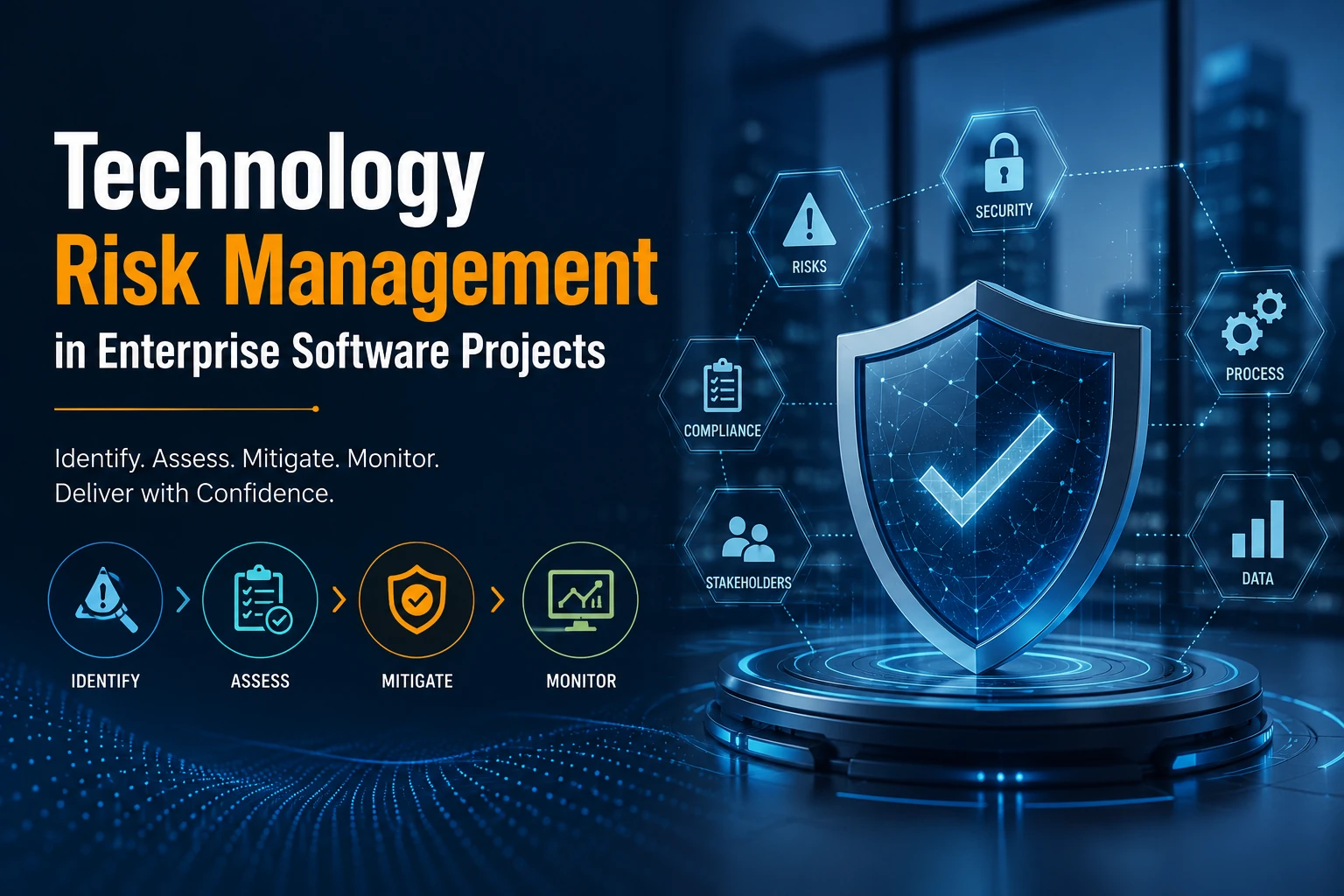
Enterprise software projects are rarely simple technology implementations. They involve complex architectures, legacy systems, third-party platforms, sensitive data, regulatory requirements, distributed teams, and significant business dependencies. As a result, technology risk management is essential for ensuring that software initiatives deliver expected business outcomes without creating unacceptable operational, security, or financial exposure.
Technology risk management is the systematic process of identifying, assessing, mitigating, monitoring, and responding to technology-related risks throughout the software development lifecycle.
For enterprise organizations, effective risk management should begin before development starts and continue through deployment, operation, maintenance, and eventual modernization.
What Is Technology Risk Management?
Technology risk management is a structured approach to managing risks associated with software, infrastructure, data, integrations, cybersecurity, and technology operations.
Common enterprise technology risks include:
- Cybersecurity vulnerabilities
- Data loss or corruption
- System outages
- Integration failures
- Legacy technology dependencies
- Poor software architecture
- Vendor and third-party risks
- Regulatory non-compliance
- Performance problems
- Project delays and cost overruns
The goal is not to eliminate every risk. That is rarely practical.
Instead, organizations should identify the most significant risks, understand their potential impact, and implement controls that reduce risk to an acceptable level.
Why Technology Risk Management Matters
Enterprise software often supports mission-critical processes. A technology failure can affect customers, employees, revenue, compliance, and business continuity.
A strong risk management framework helps organizations:
- Reduce unexpected downtime
- Protect sensitive information
- Improve software quality
- Control project costs
- Identify architectural weaknesses early
- Strengthen cybersecurity
- Improve regulatory compliance
- Increase business resilience
- Make better technology investment decisions
Risk management also enables executives to make informed decisions about technology investments and trade-offs.
Major Technology Risks in Enterprise Software Projects
1. Cybersecurity Risk
Cybersecurity is one of the most significant risks facing modern enterprise applications.
Applications can contain vulnerabilities that attackers may exploit to gain unauthorized access, steal information, disrupt operations, or compromise infrastructure.
Security risks can occur in:
- Application code
- APIs
- Databases
- Cloud infrastructure
- Identity systems
- Third-party libraries
- CI/CD pipelines
Risk Mitigation
Security should be integrated throughout the software development lifecycle.
Organizations should implement:
- Secure coding standards
- Vulnerability scanning
- Penetration testing
- Identity and access management
- Encryption
- Security monitoring
- Dependency management
- Security testing within CI/CD pipelines
A security-by-design approach is significantly more effective than addressing security issues after deployment.
2. Data Risk
Enterprise applications frequently process sensitive customer, employee, financial, and operational data.
Data-related risks include:
- Unauthorized access
- Data corruption
- Data leakage
- Poor data quality
- Inconsistent records
- Inadequate backups
- Regulatory violations
Risk Mitigation
Organizations should establish strong data governance covering:
- Data classification
- Access controls
- Encryption
- Backup and recovery
- Data retention
- Data quality
- Audit logging
Data protection requirements should be considered during application architecture and database design rather than added later.
3. Legacy System Risk
Legacy applications can become major sources of technology risk.
Older systems may rely on outdated programming languages, unsupported infrastructure, undocumented integrations, or obsolete security mechanisms.
However, replacing them immediately may not be practical.
Risk Mitigation
Organizations should assess legacy systems based on:
- Business criticality
- Security exposure
- Maintenance cost
- Integration complexity
- Performance
- Vendor support
- Modernization feasibility
Depending on the assessment, organizations can choose to:
- Retain
- Rehost
- Refactor
- Replatform
- Replace
- Retire
This allows modernization to occur according to business priorities rather than arbitrary technology timelines.
4. Architecture Risk
Poor architecture can create technical debt that becomes increasingly expensive to resolve.
Common architecture problems include:
- Tight coupling
- Poor scalability
- Single points of failure
- Inadequate observability
- Inefficient integrations
- Insufficient fault tolerance
Risk Mitigation
Enterprise architecture should address:
- Scalability
- Availability
- Performance
- Security
- Maintainability
- Interoperability
- Disaster recovery
Architecture reviews should be performed throughout the project rather than only at the beginning.
5. Third-Party and Vendor Risk
Enterprise software increasingly depends on external vendors, cloud providers, SaaS platforms, APIs, open-source libraries, and managed services.
A failure or security incident involving a third party can directly affect the enterprise.
Risk Mitigation
Organizations should evaluate vendors based on:
- Security posture
- Service-level agreements
- Compliance
- Financial stability
- Data handling practices
- Disaster recovery capabilities
- Business continuity
- Exit and migration options
Vendor risk assessments should continue throughout the relationship.
6. Integration Risk
Enterprise software rarely operates in isolation.
Applications often need to integrate with ERP, CRM, HRMS, payment systems, identity platforms, databases, data warehouses, and third-party services.
Integration failures can lead to data inconsistencies, process disruptions, and unexpected application behavior.
Risk Mitigation
Organizations should establish clear integration architecture and standards covering:
- APIs
- Authentication
- Data formats
- Error handling
- Monitoring
- Rate limits
- Version management
Automated integration testing can identify issues before production deployment.
7. Performance and Scalability Risk
An application may work effectively during development but fail when exposed to thousands or millions of users.
Performance risks can result from:
- Poor database design
- Inefficient queries
- Network bottlenecks
- Insufficient infrastructure
- Poor caching
- Inefficient application code
Risk Mitigation
Conduct performance testing before production deployment.
Testing should evaluate:
- Load
- Stress
- Scalability
- Response time
- Resource utilization
- Failover behavior
Cloud infrastructure can also provide dynamic scaling when properly designed.
8. Compliance and Regulatory Risk
Enterprise applications may be subject to privacy, security, financial, healthcare, or industry-specific regulations.
Failure to meet regulatory requirements can result in financial penalties, legal consequences, reputational damage, and operational restrictions.
Risk Mitigation
Compliance requirements should be incorporated into the software architecture and development process.
Organizations should maintain:
- Audit trails
- Access controls
- Data classification
- Retention policies
- Security monitoring
- Compliance documentation
Compliance should be treated as an ongoing operational responsibility rather than a final project checklist.
9. Project Delivery Risk
Technology risk isn’t limited to technical failures.
Enterprise projects can also experience:
- Scope creep
- Unrealistic deadlines
- Resource shortages
- Poor requirements
- Communication gaps
- Budget overruns
Risk Mitigation
Use structured project governance with:
- Clear requirements
- Defined responsibilities
- Realistic milestones
- Risk registers
- Change-control procedures
- Regular executive reporting
Early escalation is critical. Small project risks can become major problems when ignored.
Technology Risk Management Framework
A practical enterprise risk management framework can follow six stages.
Identify
Document potential technology, security, operational, project, and vendor risks.
Assess
Evaluate each risk based on:
Probability × Impact = Risk Exposure
Risks should be categorized according to their potential effect on business operations.
Prioritize
Focus resources on risks with the highest combination of likelihood and business impact.
Mitigate
Implement controls that reduce either the probability of occurrence or the potential impact.
Monitor
Continuously track risk indicators and control effectiveness.
Respond
Establish response plans for incidents that occur despite preventive controls.
Integrating Risk Management Into the SDLC
Risk management should be embedded throughout the software development lifecycle.
Planning
Identify business, regulatory, security, and technical risks before development begins.
Design
Perform architecture reviews and threat modeling.
Development
Apply secure coding practices and automated code analysis.
Testing
Conduct functional, security, performance, integration, and resilience testing.
Deployment
Use controlled release processes, monitoring, and rollback strategies.
Operations
Monitor applications continuously and regularly reassess technology risks.
Maintenance
Patch vulnerabilities, update dependencies, review architecture, and address technical debt.
Role of DevSecOps in Technology Risk Management
DevSecOps integrates security into development and operations instead of treating it as a separate stage.
A mature DevSecOps approach can include:
- Static application security testing
- Dynamic application security testing
- Software composition analysis
- Infrastructure-as-code scanning
- Container security
- Secrets management
- Continuous monitoring
This approach helps organizations identify vulnerabilities earlier while maintaining development velocity.
Building a Technology Risk Register
A technology risk register provides a centralized view of identified risks.
A typical risk register should include:
| Risk | Probability | Impact | Risk Level | Mitigation | Owner |
| Data breach | High | High | Critical | Security controls | Security Team |
| Legacy dependency | Medium | High | High | Modernization plan | Architecture Team |
| Integration failure | Medium | Medium | Medium | Automated testing | Engineering Team |
| Vendor outage | Low | High | High | DR and contingency plan | IT Operations |
| Performance issue | Medium | High | High | Load testing | Engineering Team |
The register should be actively maintained rather than treated as static project documentation.
Key Technology Risk Metrics
Executives should track measurable indicators to understand technology risk exposure.
Important metrics include:
- Number of critical vulnerabilities
- Mean time to detect incidents
- Mean time to recover
- System availability
- Failed deployment rate
- Security incident frequency
- Patch compliance
- Backup success rate
- Disaster recovery test results
- Third-party risk exposure
- Technical debt levels
These metrics provide leadership with visibility into the organization’s technology resilience.
Best Practices for Enterprise Technology Risk Management
Establish Clear Ownership
Every significant risk should have an accountable owner.
Automate Risk Detection
Use automated security scanning, monitoring, testing, and compliance checks wherever possible.
Build Resilience Into Architecture
Design systems to withstand component failures rather than assuming everything will always operate normally.
Test Disaster Recovery
A recovery plan that has never been tested cannot be considered reliable.
Maintain Documentation
Architecture diagrams, dependencies, recovery procedures, security controls, and system ownership should remain current.
Review Risks Continuously
Technology environments change rapidly. A risk assessment performed during project planning may become outdated after deployment.
Conclusion
Technology risk management is an essential component of successful enterprise software development. Cybersecurity vulnerabilities, legacy systems, poor architecture, integration failures, vendor dependencies, data risks, compliance requirements, and project delivery challenges can all affect the success of an enterprise technology initiative.
Organizations can reduce these risks by adopting a structured framework that identifies, assesses, prioritizes, mitigates, monitors, and responds to technology risks throughout the software lifecycle.
The most effective approach is proactive rather than reactive. By integrating security, resilience, governance, testing, and risk management into enterprise architecture and software delivery, organizations can improve reliability while continuing to innovate.
Ultimately, technology risk management is not about avoiding technology risk altogether—it is about understanding risk clearly and managing it intelligently while pursuing business growth and digital transformation.
FAQs
Technology risk management is the process of identifying, assessing, mitigating, and monitoring risks associated with enterprise software, infrastructure, data, cybersecurity, integrations, vendors, and technology operations.
Common risks include cybersecurity vulnerabilities, data loss, legacy system dependencies, poor architecture, integration failures, performance issues, vendor risks, compliance challenges, and project delivery problems.
Enterprises can reduce risk through secure architecture, automated testing, cybersecurity controls, data governance, vendor assessments, disaster recovery planning, continuous monitoring, and structured technology governance.
Security-by-design incorporates cybersecurity into architecture, development, testing, and deployment from the beginning. This helps identify and address vulnerabilities earlier and reduces the cost and impact of security issues.
Organizations can track metrics such as critical vulnerabilities, system availability, security incidents, recovery time, patch compliance, failed deployments, backup success rates, and disaster recovery test results to monitor technology risk exposure.