


Artificial intelligence (AI) has evolved from an experimental technology into a strategic business asset across regulated industries. Financial institutions use AI to detect fraud and automate underwriting, healthcare providers rely on AI for diagnostics and patient care, while pharmaceutical companies, insurers, manufacturers, and energy providers leverage intelligent systems to improve operational efficiency and decision-making.
As AI adoption accelerates, regulatory expectations are becoming more stringent. Organizations are now expected to demonstrate that AI systems are transparent, secure, explainable, ethical, and compliant throughout their lifecycle. This shift places greater responsibility on CIOs, Chief Risk Officers, compliance leaders, and executive boards to establish governance structures that support innovation without compromising trust or regulatory obligations.
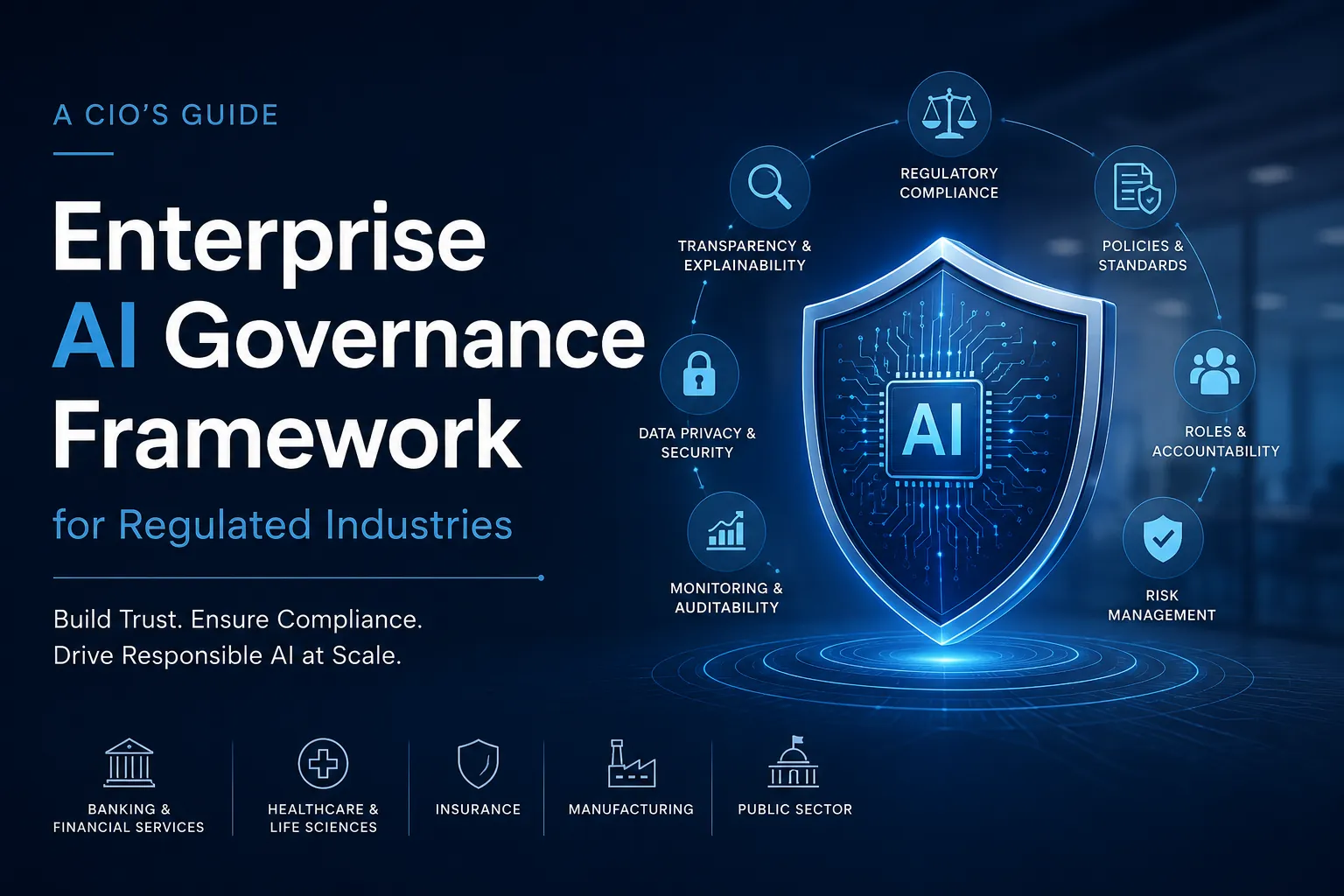
An Enterprise AI Governance Framework for Regulated Industries provides the foundation for achieving this balance. It defines the policies, processes, technologies, and accountability required to manage AI risks while enabling organizations to confidently scale AI initiatives. Rather than acting as a barrier to innovation, effective governance creates a controlled environment where AI can deliver measurable business value responsibly.
This article explores why AI governance has become a strategic imperative, the core components of an enterprise governance framework, implementation best practices, common challenges, and the long-term business benefits for regulated organizations.
Why AI Governance Has Become a Business Imperative
Artificial intelligence is increasingly influencing decisions that have significant financial, legal, operational, and societal implications. Whether approving loans, identifying fraudulent transactions, assisting medical professionals, or optimizing critical infrastructure, AI systems are now involved in processes that require high levels of accuracy, fairness, and accountability.
As regulators introduce AI-specific legislation and strengthen existing compliance requirements, organizations must ensure that every AI model operates within defined governance standards. AI governance provides the structure necessary to reduce uncertainty while ensuring AI initiatives remain aligned with organizational objectives.
A mature governance framework helps organizations:
- Improve transparency in AI-driven decisions.
- Reduce regulatory and compliance risks.
- Protect sensitive customer and enterprise data.
- Minimize algorithmic bias and ethical concerns.
- Strengthen cybersecurity and operational resilience.
- Increase stakeholder confidence in AI initiatives.
Without formal governance, organizations may encounter inconsistent AI outcomes, undocumented models, data privacy issues, poor auditability, and unauthorized use of AI tools across departments. These risks can significantly impact regulatory compliance and organizational reputation.
The Growing Regulatory Landscape
Governments and regulatory authorities worldwide are rapidly developing policies to govern artificial intelligence. While regulations vary by region and industry, they generally focus on transparency, accountability, risk management, privacy protection, and responsible AI development.
Organizations operating in regulated sectors must proactively prepare for increasing oversight rather than reacting after new regulations become mandatory.
Financial Services
Banks, insurance companies, and financial institutions increasingly rely on AI for credit scoring, fraud detection, anti-money laundering, investment analysis, and customer service. Governance ensures these AI models remain explainable, properly validated, and compliant with financial regulations while reducing model risk.
Healthcare
Healthcare organizations use AI to support diagnostics, patient monitoring, clinical decision-making, and administrative automation. Governance frameworks help ensure patient safety, protect confidential health information, and maintain compliance with healthcare privacy regulations.
Pharmaceuticals
AI supports drug discovery, manufacturing optimization, quality assurance, and clinical research. Governance ensures AI systems maintain scientific integrity through comprehensive validation, documentation, and quality management processes.
Energy and Utilities
Energy providers increasingly deploy AI for predictive maintenance, grid optimization, cybersecurity, and operational monitoring. Governance helps protect critical infrastructure while ensuring AI systems remain secure and resilient.
Government and Public Sector
Public sector organizations require strong governance to ensure fairness, transparency, and accountability in AI-assisted decision-making that directly impacts citizens and public services.
As regulatory expectations continue evolving, organizations with mature governance programs will be better positioned to adapt while maintaining operational continuity.
Core Components of an Enterprise AI Governance Framework
Successful AI governance extends beyond compliance documentation. It combines executive leadership, standardized policies, technical controls, risk management, and continuous monitoring to establish a repeatable governance model across the enterprise.
Executive Governance Structure
AI governance begins with executive ownership. Governance should not be managed exclusively by technology teams but should involve collaboration across multiple business functions.
A cross-functional AI Governance Committee often includes representatives from:
- Chief Information Officer (CIO)
- Chief Information Security Officer (CISO)
- Chief Risk Officer (CRO)
- Compliance and Legal teams
- Data Governance leaders
- Privacy officers
- Business stakeholders
This committee is responsible for establishing governance policies, approving high-risk AI initiatives, monitoring regulatory compliance, reviewing ethical considerations, and ensuring organizational accountability.
Executive sponsorship also helps align AI governance with broader business objectives and enterprise risk management strategies.
AI Risk Classification
Every AI application presents a different level of business and regulatory risk. Treating all AI initiatives equally often leads to unnecessary complexity or inadequate oversight.
Organizations should classify AI systems according to their potential impact.
High-risk applications may include:
- Credit approvals
- Clinical diagnosis
- Fraud detection
- Automated underwriting
- Critical infrastructure operations
These applications typically require extensive testing, executive approval, comprehensive documentation, and continuous monitoring.
Medium-risk applications often include:
- Predictive maintenance
- Workforce planning
- Internal analytics
- Supply chain optimization
These solutions generally require standard governance controls with periodic reviews.
Low-risk applications may include:
- Internal document search
- Marketing automation
- Employee productivity assistants
- Knowledge management tools
Applying governance proportionate to risk enables organizations to allocate resources efficiently while maintaining compliance.
AI Lifecycle Governance
Governance should extend throughout the complete AI lifecycle rather than focusing solely on deployment.
Planning
Every AI initiative should begin with a clear business objective, regulatory assessment, stakeholder alignment, and risk evaluation. Early planning helps identify governance requirements before development begins.
Development
Development teams should prioritize:
- Data quality validation
- Secure development practices
- Bias testing
- Model documentation
- Privacy impact assessments
Embedding governance during development reduces downstream compliance issues.
Deployment
Before deployment, organizations should conduct security assessments, compliance reviews, model validation, and formal approval processes to ensure readiness for production.
Operations
Governance continues after deployment through:
- Continuous performance monitoring
- Drift detection
- Security monitoring
- Bias evaluation
- Compliance audits
- Incident response procedures
Retirement
Retiring AI systems should follow controlled processes that include documentation retention, secure decommissioning, and compliance with regulatory record-keeping requirements.
Embedding governance across every lifecycle stage improves both operational consistency and long-term AI reliability.
Data Governance Integration
High-quality AI depends on high-quality data. Poor governance over enterprise data often leads to inaccurate predictions, biased outcomes, compliance violations, and reduced business confidence.
AI governance should integrate seamlessly with enterprise data governance programs by establishing controls for:
- Data quality
- Data lineage
- Metadata management
- Privacy protection
- Data classification
- Consent management
- Access controls
- Data retention policies
Strong data governance creates trustworthy AI while improving audit readiness and regulatory compliance.
Model Risk Management
Unlike traditional software, AI models continuously evolve as business environments and datasets change. Without ongoing oversight, even well-performing models may gradually become inaccurate or biased.
A mature model governance program should include:
- Version control
- Independent model validation
- Performance benchmarking
- Explainability testing
- Model drift detection
- Scheduled retraining
- Comprehensive documentation
- Change management procedures
Continuous model oversight helps organizations maintain confidence in AI-driven decisions while reducing operational risk.
Responsible AI Principles
Responsible AI should be embedded into governance policies from the beginning rather than added later as a compliance exercise.
Organizations should establish principles that emphasize:
Fairness – Reducing unintended bias and ensuring equitable outcomes.
Transparency – Providing meaningful explanations for AI-generated decisions.
Accountability – Assigning ownership throughout the AI lifecycle.
Privacy – Protecting sensitive information using strong security and privacy controls.
Human Oversight – Maintaining appropriate human review for high-impact decisions.
These principles strengthen organizational trust while supporting ethical AI adoption.
Governance Controls Every Regulated Enterprise Should Implement
Effective governance relies on standardized controls that can be consistently applied across every AI initiative.
Organizations should establish enterprise-wide policies covering AI development, third-party AI usage, generative AI adoption, cybersecurity requirements, data handling practices, and regulatory compliance expectations.
Governance should also include formal approval processes that ensure high-risk AI solutions undergo appropriate reviews before deployment.
To improve audit readiness, organizations should maintain documentation such as:
- AI model cards
- Risk assessments
- Validation reports
- Testing documentation
- Decision logs
- Compliance evidence
Continuous monitoring should evaluate model performance, security events, bias indicators, operational metrics, and regulatory compliance to identify issues before they become significant risks.
Technology Enablers for AI Governance
As AI adoption expands, manual governance processes become increasingly difficult to manage. Organizations are therefore investing in governance platforms that automate oversight while improving consistency and scalability.
Modern AI governance technologies commonly support:
- AI asset inventories
- Model lifecycle management
- Automated compliance reporting
- Policy enforcement
- Explainability dashboards
- Risk scoring
- Audit logging
- Continuous monitoring
Automation allows governance teams to oversee growing AI portfolios without significantly increasing operational overhead.
Common Challenges Facing CIOs
Implementing enterprise AI governance is not without challenges. Many organizations struggle with fragmented ownership, evolving regulations, legacy technology environments, and rapidly expanding AI adoption.
One growing concern is Shadow AI, where employees independently use public AI tools without organizational approval. These unauthorized deployments may expose sensitive information and create compliance risks.
Organizations also face challenges when different departments develop AI independently without centralized governance. This fragmented approach often results in inconsistent documentation, duplicated efforts, and varying compliance standards.
Managing third-party AI vendors presents another layer of complexity, requiring organizations to evaluate vendor security, transparency, and regulatory compliance before integrating external AI solutions.
Successfully addressing these challenges requires executive sponsorship, standardized governance policies, and collaboration across technology, security, legal, compliance, and business teams.
Best Practices for Building a Mature AI Governance Program
Developing a successful governance program requires a long-term strategic approach rather than a one-time compliance initiative.
Organizations should begin by securing executive sponsorship and establishing governance as an enterprise-wide priority. Cross-functional collaboration between IT, cybersecurity, legal, compliance, data governance, and business leaders ensures governance decisions reflect both technical and business perspectives.
Several practices consistently contribute to successful AI governance:
- Develop enterprise-wide AI governance policies.
- Standardize documentation across all AI initiatives.
- Establish risk-based approval workflows.
- Continuously monitor deployed AI models.
- Conduct periodic governance reviews.
- Prepare evidence for regulatory audits.
- Invest in employee awareness and AI governance training.
Governance should continuously evolve alongside business objectives, technological advancements, and regulatory requirements.
Business Benefits of Enterprise AI Governance
Although governance is often viewed through the lens of compliance, its business value extends much further.
Organizations with mature governance frameworks often experience improved operational efficiency, stronger stakeholder confidence, faster regulatory approvals, and reduced business risk. Standardized governance also accelerates AI adoption by providing clear processes that reduce uncertainty for development teams.
Key business benefits include:
- Faster AI deployment with standardized governance
- Reduced compliance and regulatory risk
- Greater transparency and accountability
- Improved customer and stakeholder trust
- Better model accuracy and reliability
- Enhanced cybersecurity resilience
- Stronger enterprise-wide AI adoption
- Improved audit readiness
Rather than limiting innovation, governance enables organizations to scale AI responsibly and sustainably.
The Future of AI Governance
As artificial intelligence continues to mature, governance frameworks will become increasingly automated, intelligent, and integrated into enterprise risk management.
Organizations are expected to adopt technologies such as continuous compliance monitoring, AI risk scoring, automated policy enforcement, and Policy-as-Code to simplify governance at scale. Future governance programs will increasingly combine cybersecurity, privacy, enterprise architecture, data governance, and AI oversight into unified governance platforms.
Organizations that establish mature governance capabilities today will be significantly better prepared to navigate evolving regulations while maximizing the long-term value of their AI investments.
Conclusion
An Enterprise AI Governance Framework for Regulated Industries is no longer simply a compliance requirement—it is a strategic business capability that enables organizations to innovate responsibly while managing risk effectively.
By embedding governance across the AI lifecycle, organizations can improve transparency, strengthen regulatory readiness, reduce operational risk, and build lasting trust with customers, regulators, and stakeholders.
For CIOs, risk leaders, and compliance professionals, the goal is not to restrict AI innovation but to create a governance model that supports secure, ethical, and scalable AI adoption. Organizations that invest in governance today will be better positioned to realize the full potential of artificial intelligence while remaining resilient in an increasingly regulated digital economy.
FAQs
An Enterprise AI Governance Framework is a structured set of policies, processes, controls, and accountability mechanisms that guide how artificial intelligence is developed, deployed, monitored, and retired across an organization. It helps ensure AI systems are secure, compliant, ethical, transparent, and aligned with business objectives while minimizing operational and regulatory risks.
Regulated industries such as banking, healthcare, insurance, pharmaceuticals, and energy operate under strict legal and compliance requirements. AI governance helps organizations:
- Meet regulatory obligations
- Reduce model and operational risk
- Improve transparency and explainability
- Protect sensitive data and customer privacy
- Prevent bias and unethical AI outcomes
- Build trust with regulators, customers, and stakeholders
Without a formal governance framework, AI initiatives can expose organizations to compliance violations, financial penalties, and reputational damage.
A comprehensive Enterprise AI Governance Framework typically includes:
- Executive governance and accountability
- AI risk classification and assessment
- Data governance and privacy controls
- Model lifecycle management
- Responsible AI principles (fairness, transparency, accountability)
- Security and compliance monitoring
- Documentation and audit trails
- Continuous performance and risk monitoring
Together, these components create a scalable and repeatable governance model for enterprise AI.
Organizations should take a proactive approach by:
- Establishing cross-functional AI governance committees
- Creating enterprise-wide AI policies and standards
- Maintaining detailed documentation for AI models
- Implementing continuous monitoring and model validation
- Conducting regular AI risk assessments
- Aligning governance practices with emerging global AI regulations and industry standards
Preparing early enables organizations to adapt more efficiently as regulatory requirements continue to evolve.
Effective AI governance provides clear guidelines, standardized processes, and built-in risk controls that allow teams to innovate with confidence. Instead of creating bottlenecks, governance helps organizations:
- Accelerate AI deployment through standardized approvals
- Improve collaboration between IT, risk, legal, and business teams
- Reduce costly compliance issues and rework
- Increase stakeholder confidence in AI-driven decisions
- Scale AI initiatives responsibly across the enterprise
A mature governance framework enables organizations to innovate faster while maintaining compliance, security, and trust.