



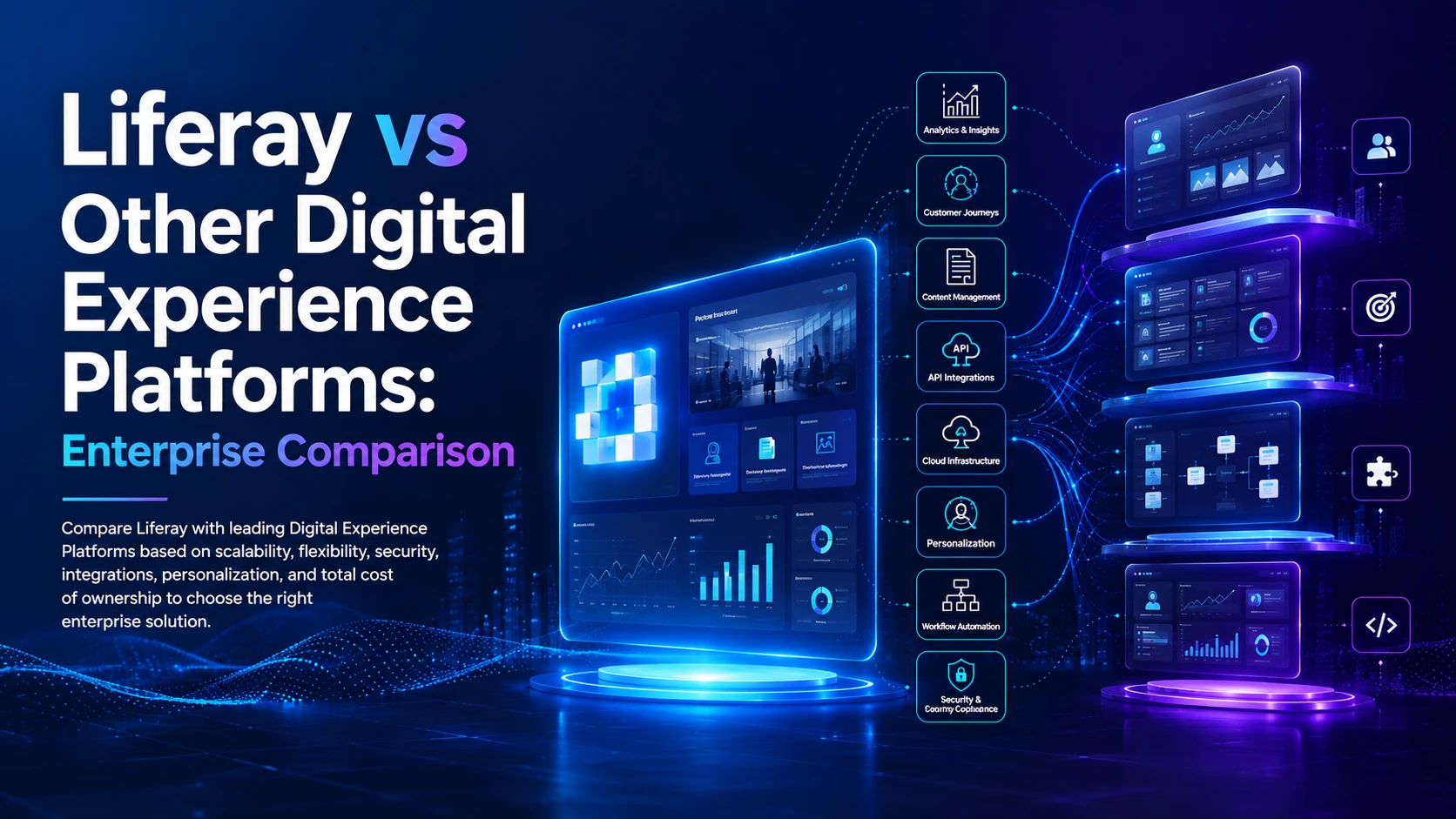
Digital transformation has fundamentally changed how organizations interact with customers, employees, and partners. Modern enterprises require more than a traditional content management system (CMS); they need a Digital Experience Platform (DXP) capable of delivering personalized, secure, and connected digital experiences across multiple channels.
As businesses evaluate DXP solutions, Liferay consistently emerges as one of the strongest enterprise platforms. However, organizations also consider alternatives such as Adobe Experience Manager (AEM), Sitecore, Optimizely, Acquia DXP, and Microsoft SharePoint.
The question isn’t simply “Which DXP is best?” Rather, it’s “Which platform best aligns with your organization’s business goals, IT strategy, scalability requirements, and budget?”
This guide compares Liferay with other leading Digital Experience Platforms across architecture, features, security, integrations, scalability, licensing, and enterprise use cases to help decision-makers make an informed investment.
What Is a Digital Experience Platform (DXP)?
A Digital Experience Platform is an integrated software solution that enables organizations to create, manage, personalize, and optimize digital experiences across websites, portals, mobile applications, customer self-service platforms, intranets, and partner ecosystems.
Unlike a traditional CMS, a DXP combines multiple enterprise capabilities, including:
- Content management
- User authentication
- Customer portals
- Employee intranets
- Workflow automation
- Personalization
- API integrations
- Analytics
- Multi-channel publishing
- Digital asset management
Modern enterprises rely on DXPs to unify customer and employee experiences while integrating seamlessly with existing enterprise systems.
Understanding Liferay DXP
Liferay DXP is an enterprise-grade Digital Experience Platform designed for organizations that require secure, scalable, and customizable digital solutions.
Rather than focusing solely on marketing websites, Liferay excels at building:
- Customer portals
- Employee portals
- Partner portals
- Government service portals
- Self-service applications
- Enterprise intranets
- Digital workplaces
- Knowledge management systems
Its open architecture allows organizations to integrate virtually any enterprise application while maintaining complete control over customization.
Why Enterprises Choose Liferay
Organizations select Liferay because it addresses complex enterprise requirements that many traditional CMS platforms struggle to support.
Major advantages include:
- Enterprise scalability
- Open-source flexibility
- Extensive customization
- Advanced workflow engine
- Multi-site management
- Role-based permissions
- API-first architecture
- Cloud and on-premises deployment
- Strong security framework
- Long-term cost efficiency
These capabilities make Liferay particularly attractive for large organizations with evolving digital ecosystems.
Liferay vs Adobe Experience Manager (AEM)
Platform Focus
Adobe Experience Manager focuses heavily on digital marketing, content management, and personalized customer experiences.
Liferay focuses on enterprise portals, digital workplaces, and integrated business applications.
Strengths of Adobe Experience Manager
- Advanced digital marketing tools
- Exceptional content authoring
- Powerful digital asset management
- AI-driven personalization
- Adobe Experience Cloud integration
Strengths of Liferay
- Enterprise portal development
- Business workflow automation
- Lower implementation complexity
- Better enterprise integrations
- Flexible deployment models
- Strong user permission management
Best Fit
Choose Adobe Experience Manager if marketing teams require sophisticated content personalization and campaign management.
Choose Liferay if your organization needs integrated enterprise portals and digital workplace solutions.
Liferay vs Sitecore
Content Management
Sitecore excels in personalized marketing experiences and omnichannel content delivery.
Liferay provides strong content management while emphasizing enterprise collaboration and operational efficiency.
Customization
Both platforms are highly customizable.
However, Liferay’s modular architecture and open framework often allow greater development flexibility without extensive licensing constraints.
Deployment
Both platforms support:
- Cloud
- Hybrid
- On-premises
Liferay generally offers greater deployment flexibility for organizations with strict infrastructure requirements.
Liferay vs Optimizely
Optimizely is known for:
- Experimentation
- A/B testing
- Digital commerce
- Marketing optimization
Liferay focuses more on enterprise business applications than marketing experimentation.
Organizations prioritizing operational efficiency often find Liferay a stronger long-term platform.
Liferay vs SharePoint
Many organizations compare Liferay with Microsoft SharePoint.
Although both support collaboration, their objectives differ.
SharePoint
Ideal for:
- Internal document management
- Team collaboration
- Microsoft ecosystem
- File sharing
Liferay
Ideal for:
- Customer portals
- Employee portals
- External users
- Enterprise applications
- Self-service platforms
- Digital transformation
For organizations building external-facing digital ecosystems, Liferay typically offers significantly more flexibility.
Liferay vs Acquia DXP
Acquia DXP, built on Drupal, emphasizes content-rich websites and marketing experiences.
Liferay emphasizes enterprise integration, workflow automation, and secure digital services.
Acquia is often selected by organizations with content-heavy publishing requirements.
Liferay is preferred for organizations requiring enterprise business applications.
Integration Capabilities
Modern enterprises rely on dozens of business systems.
Liferay integrates with:
CRM Platforms
- Salesforce
- Microsoft Dynamics
- HubSpot
ERP Systems
- SAP
- Oracle
- Microsoft Dynamics 365
Identity Providers
- Azure Active Directory
- Okta
- LDAP
- SAML
- OAuth
- OpenID Connect
Cloud Services
- AWS
- Microsoft Azure
- Google Cloud
Enterprise Applications
- REST APIs
- SOAP APIs
- Legacy systems
- Databases
- Microservices
Its API-first architecture significantly simplifies enterprise integration.
Security Comparison
Security remains one of the primary reasons enterprises adopt Liferay.
Key capabilities include:
Identity Management
- Single Sign-On
- Multi-Factor Authentication
- Role-Based Access Control
- User Groups
Data Protection
- Encryption
- Secure authentication
- Audit logging
- Session management
Compliance Support
Liferay supports organizations working toward compliance with:
- GDPR
- HIPAA
- ISO standards
- Government security frameworks
Performance and Scalability
Enterprise platforms must support thousands—or even millions—of users.
Liferay provides:
- Horizontal scaling
- Load balancing
- Distributed caching
- High availability
- Container support
- Kubernetes deployment
- Cloud-native architecture
These capabilities enable organizations to expand without replacing their platform.
Personalization Capabilities
Modern DXPs must deliver personalized experiences.
Liferay enables organizations to personalize:
- Landing pages
- User dashboards
- Navigation
- Content visibility
- User roles
- Recommendations
While Adobe and Sitecore offer more advanced AI-driven marketing personalization, Liferay provides strong business-focused personalization suitable for enterprise portals and digital workplaces.
Licensing and Total Cost of Ownership
Cost is often a deciding factor.
Compared with proprietary enterprise platforms, Liferay frequently delivers a lower total cost of ownership because of:
- Flexible licensing
- Reduced vendor lock-in
- Lower infrastructure costs
- Faster customization
- Open architecture
- Long-term maintainability
Organizations should evaluate not only licensing fees but also implementation, maintenance, training, and future expansion costs.
Industries That Benefit Most from Liferay
Liferay has proven successful across many industries.
Government
Government agencies use Liferay to build citizen portals, online services, and secure digital platforms.
Healthcare
Healthcare organizations leverage Liferay for patient portals, provider collaboration, and secure information sharing.
Financial Services
Banks and insurance companies deploy secure customer portals and internal collaboration systems.
Manufacturing
Manufacturers streamline supplier collaboration, customer support, and operational workflows.
Education
Universities create digital campuses, student portals, and faculty collaboration platforms.
Retail
Retail organizations improve partner communication, vendor management, and customer engagement.
When Should You Choose Liferay?
Liferay is an excellent choice if your organization needs:
- Enterprise portals
- Digital workplace solutions
- Secure authentication
- Extensive integrations
- Workflow automation
- Long-term scalability
- Multi-site management
- API-first architecture
- Flexible deployment
- Enterprise-grade security
Organizations focused primarily on digital marketing campaigns may prefer Adobe Experience Manager or Sitecore.
However, organizations pursuing enterprise digital transformation typically find Liferay to be one of the most versatile and future-ready platforms available.
Best Practices for Selecting a Digital Experience Platform
Define Business Objectives
Identify whether your priority is customer engagement, employee productivity, partner collaboration, or digital services.
Evaluate Integration Requirements
Ensure the platform connects seamlessly with your existing CRM, ERP, HRMS, and cloud infrastructure.
Consider Long-Term Growth
Choose a solution that supports increasing users, applications, and digital channels without major redevelopment.
Prioritize Security
Look for enterprise-grade authentication, access controls, encryption, auditing, and compliance support.
Assess Total Cost of Ownership
Evaluate implementation, customization, infrastructure, licensing, maintenance, and support—not just the initial purchase price.
Plan for Future Innovation
Select a platform with a modern architecture that can support AI, automation, APIs, cloud-native deployments, and evolving customer expectations.
Conclusion
Selecting the right Digital Experience Platform is a strategic investment that influences customer satisfaction, employee productivity, operational efficiency, and long-term business growth.
While platforms such as Adobe Experience Manager, Sitecore, Optimizely, and SharePoint each excel in specific scenarios, Liferay stands out for organizations seeking a highly customizable, secure, scalable, and integration-friendly enterprise platform. Its ability to power customer portals, employee intranets, self-service applications, and digital workplaces makes it an excellent choice for enterprises across government, healthcare, finance, manufacturing, education, and other regulated industries.
For organizations embarking on digital transformation, Liferay offers the flexibility, performance, and enterprise capabilities needed to build connected digital experiences that can evolve with future business needs.
FAQs
Liferay stands out for its open-source foundation, extensive customization capabilities, enterprise-grade security, and seamless integration with existing business systems. Unlike many proprietary DXPs, Liferay offers greater flexibility while reducing vendor lock-in.
Yes. Liferay is designed for enterprises that require scalable, secure, and highly customizable digital experiences. It supports complex business processes, high user volumes, and multi-site, multilingual deployments across industries.
Liferay provides robust content management, customer portals, workflow automation, and integration capabilities at a lower total cost of ownership for many organizations. While Adobe Experience Manager and Sitecore excel in marketing-focused features, Liferay is often preferred for enterprise portals, intranets, and digital workplace solutions.
Absolutely. Liferay integrates with ERP, CRM, HRMS, identity management systems, cloud platforms, REST APIs, and legacy enterprise applications, enabling organizations to create a unified digital experience without replacing existing infrastructure.
Liferay is an excellent choice for government agencies, healthcare providers, financial institutions, manufacturers, educational organizations, and large enterprises seeking a secure, scalable, and customizable Digital Experience Platform that supports long-term digital transformation initiatives.